
Water problems
Hard water: signs, causes, and fixes
What hard water is, how to tell if you have it, how hardness is measured in mg/L and grains per gallon, and how a softener sized to your water fixes it.
Hard water carries dissolved calcium and magnesium picked up as water moves through rock and soil. It isn't a health hazard, and the EPA doesn't set a limit for it. It is, however, the most common reason people buy a water softener. Scale forms when hard water is heated or evaporates, so you see it first on fixtures, shower glass, kettles, and inside water heaters.
Signs you have hard water
- White or chalky crust on faucets, shower heads, and glass doors
- Spots on dishes and glassware after the dishwasher
- Soap and shampoo that lather poorly, and a filmy feel after showering
- Scale in kettles and coffee makers, and water heaters that lose efficiency
How hardness is measured
Water reports list hardness in milligrams per liter (mg/L) as calcium carbonate. Softener sizing uses grains per gallon (gpg); one grain per gallon equals 17.1 mg/L. The USGS classifies water as soft at 0–60 mg/L, moderately hard at 61–120 mg/L, hard at 121–180 mg/L, and very hard above 180 mg/L[1].
| Where | Reported hardness |
|---|---|
| Philadelphia Water, Baxter plant (2024 average) | 98 mg/L (about 6 gpg)[2] |
| Philadelphia Water, Belmont plant | 152 mg/L (about 9 gpg) |
| Philadelphia Water, Queen Lane plant | 168 mg/L (about 10 gpg) |
| New Jersey American Water, Raritan system (Hunterdon, Mercer, Somerset) | 5–13 gpg[3] |
Hardness varies from utility to utility and even from plant to plant, so the number that matters is yours. If you're on public water, it's in your utility's annual Consumer Confidence Report[4]. If you're on a private well, a test is the only way to know.
How to fix hard water
A salt-based ion-exchange water softener swaps calcium and magnesium for sodium or potassium and is the standard fix. Sizing depends on your hardness, your household's water use, and your plumbing's flow rate. Iron in the water also uses up softening capacity, which is why we size from a test rather than a guess. Iron filters and reverse osmosis don't soften water, though many homes pair a softener with reverse osmosis for drinking water.
Solutions that help
Systems we'd typically recommend
From the WÜDR range. The exact model, configuration and sizing follow your water analysis.
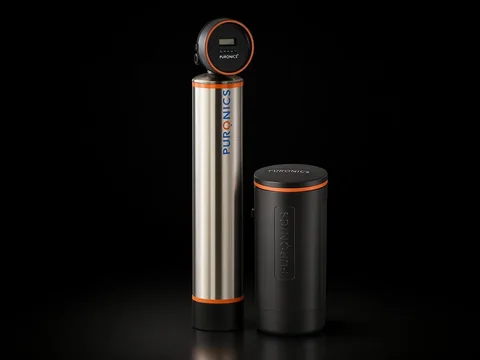
What drives the price? See Water softener cost. Every recommendation starts with your free water report.
See measured figures for your area: water hardness by town.
Where this comes up in our service area
Common questions
Is hard water bad for my health?
Hardness minerals aren't considered a health risk, and the EPA has no drinking water limit for hardness. The problems are scale, spots, soap use, and wear on water-using appliances.
What hardness level needs a softener?
There's no single cutoff. The USGS calls water above 120 mg/L (about 7 gpg) hard, and many homeowners notice scale well below that. We look at your hardness, iron, and water use before recommending anything.
Does a filter remove hardness?
No. Carbon and sediment filters don't remove calcium and magnesium. You need a softener (ion exchange) for that.
Clean water starts with knowing what's in it.
Sources
- USGS Water Science School: Hardness of water. www.usgs.gov/special-topics/water-science-school/science/hardness-water
- Philadelphia Water Department: 2024 Water Quality Report (PDF). water.phila.gov/wp-content/uploads/files/2024-pwd-water-quality-report.pdf
- NJ American Water: Raritan/Hunterdon/Mercer/Somerset typical water quality (PDF). amwater.com/njaw/resources/raritanhunterdonmercersomerset_twq.pdf
- U.S. EPA: Consumer Confidence Reports (CCR) information for consumers. www.epa.gov/ccr/ccr-information-consumers
EPA records retrieved Oct 2026 from the EPA SDWIS and UCMR 5 public datasets. Utility records describe a water system, not the tap in your home. Records can lag and may be incomplete.